Sepia Tone

Friday, February 27, 2009


Times Of India - another Interview with Sudha Murthy on another occasion.


Thursday, July 12, 2007

Tamil on the Web

Naa. Govindasamy's Interview in 1995, soon after his efforts to upload "Keyed in Tamil scripts" on the Internet succeeded. Before that the Tamil fonts were uploaded in pix format.

Page 1.
Page 2.
Page 3.

Tamil Net 97 and 2000

Tamil Net 97


*******
Profile of Dr. Kalyanasundaram - Interviewed soon after the Tamil Internet Conf. in 2000 / Singapore.


and

Murasu Anjal's Muthu Nedumaran talks on Tamil Internet to Times of India -

http://www1.timesofindia.indiatimes.com/articleshow/161769.cms

************

Tamil Internet Conference : 2000 - Singapore. - Economic Times Article archived here:

http://www.tamil.net/list/2000-07/msg00644.html

************

Thursday, March 24, 2005

News report published in Business Times - Singapore - 1998.

India to contest US firm's patent for basmati rice

US' Ricetec claims to have invented new way of growing crop

By Aruna Srinivasan
NEW DELHI

INDIA will challenge a US patent for an aromatic rice that is said to
be similar to the basmati strain grown in northern India and Pakistan.

The government, together with local rice traders, has decided to apply
to the US Patent Office for a revocation of the patent given to
Texas-based Ricetec.

The US company obtained the patent on the basis of its claim to have
invented a novel method of growing rice plants that are identical in
characteristics to the basmati.

Ricetec has branded its strain Texmati. The patent allows the company
to sell the new strain of rice under the generic name of basmati.

Indian rice growers contend that strains of rice developed outside the
traditional geographical area is not of the same quality as the
original ones even if they are claimed to have similar
characteristics.

Rice exporters argue that, in effect, the US company was trying to
pass off a spurious variety as the real one.

The patent threatens to rob Indian traders of their worldwide market.
America alone accounts for 10 per cent, or 45,000 tonnes, of India's
basmati exports.

According to R A Mashelkar, director-general of the Council of
Scientific and Industrial Research, the key issue is how the American
variety is being described. By using the generic name basmati,
consumers are likely to think that it is the same as that grown in the
Indian sub-continent.

What is at stake is India's half million tonnes of basmati trade, said
Dr Mashelkar.

Ecologist and activist Vandana Shiva said that if the US patent of
basmati is not challenged now, Indian farmers will eventually end up
paying royalties to corporations like Ricetec for growing a rice
variety which they have been cultivating for generations.

This is because, according to US laws, once a patent is granted for a
generic trait (in this case the aroma) all occurrences of that trait
will be deemed an infringement, irrespective of how they came to exist
in the first place, she said.

Meanwhile, there is talk that India's case may not be very strong
since basmati is essentially a generic name for a particular grain of
rice. Sources point out that it may not be as straightforward a case
as those for turmeric and neem. India won the cases last year against
US patenting of the healing properties of the herbs. But given the
success of these two earlier cases, Indian officials are confident of
winning this time round too.

Yesterday, US Ambassador to India Richard Celeste expressed surprise
over the granting of the patent.

Measures are underway in India to protect agro-products traditionally
grown in certain geographical areas by legislation, and the
Geographical Appellations Act, is expected to be in place when the new
government takes over.

Copyright Singapore Press Holdings Ltd, 1998. All rights reserved.

Aruna Srinivasan.
New Delhi.


India steps up action to counter bio- piracy and increase plant based production of drugs.

Council of Scientific and Industrial Research (CSIR), India’s state funded central research nerve cell is charting new courses to face the challenges in the future patent regime, which will have significant implications for the Indian pharmaceutical industry. Prime among the new strategies is the attempt to manufacture medicines from 160 rare herbs and patent them for global market. The properties of the identified plants will be researched and the scientists will produce molecules from the properties of these plants to treat 20 human diseases. Besides using the infrastructure of the 18 of the 40 laboratories of the central research agency, the ambitious programme called plant- based bioactives, will have an initial funding of Rs. 100 million ( S$ 3.7 million) and will be increased every year as the project progresses.

India’s share in the US$20 million global plant-based-drug market is a negligible percentage. But given the latent knowledge base, the country has the capacity of making a greater impact in plant-based medicines. In a Rs.9000 crore domestic market, the Indian production is pegged around Rs.2300 crores. CSIR envisages a significant increase in the figure to Rs. 4000 crores by the turn of the century.

The inclusion of Intellectual Property Rights (IPR) in the GATT agreement threw some significant challenges to India’s bio-diversity resources, and particularly to the Indian pharmaceutical industry, which hitherto relied largely on the traditional knowledge bank to produce many of its herbal-based drugs.

“ India is endowed with rich medicinal plants. The knowledge till now was essentially spread through word of mouth. But if left unprotected in the new patent regime, there is the danger of losing our knowledge to global competitors. However, our research is based not only on traditional knowledge bank, but we also combine our own intellectual prowess to give it a scientific base. We aim to develop a standardization and documentation of the traditional knowledge so that they are protected from a bio- piracy in future and we simultaneously research and develop new combinations to market at global level.” says Dr. Raghunath Anant Mashelkar, Director General, CSIR

One of the main concerns of the Indian scientists is that a situation in future should not arise where in a global competition gets patent rights for a discovery, which essentially was based on the Indian traditional knowledge or the new research base. Hence the urgency to protect them by patenting.

Besides aggressively going in for patenting every new discovery, the CSIR today has got down in a patent literacy campaign. “ There is a wrong perception among many Indians that the patent laws patent the plants themselves. It is not so. Only the specific constituents of the plants in relation to their efficacy and impacts are patented.,” explains Mashelkar.

The Indian research agency recently won a landmark case in August when the US Patent and Trade Mark Office( US PTO) rejected a patent earlier given to the University of Mississippi Medical Centre, USA, for the use of turmeric powder as a wound-healing agent. Since the wound healing property of turmeric was an existing knowledge in India, the Indians argued that one of the basic criterion for the grant - novelty, of a patent was not met. The US body accepted it and rejected the earlier claim by the University of Mississippi.

The success of the case has wider implications to the third world countries since most of them have an undocumented wealth of traditional knowledge.

As a member of WTO, India has agreed to amend its patent laws, by the year 2005, to synchronies with a global system of patenting. It recently faced an adverse verdict from the dispute settlement body of the WTO for not starting the process to meet the obligation by the target date.

Published in Business Times Dated: October 13, 1997.

Thursday, July 01, 2004

Aruna Srinivasan.

Date Line:
Singapore.
17.12.96.


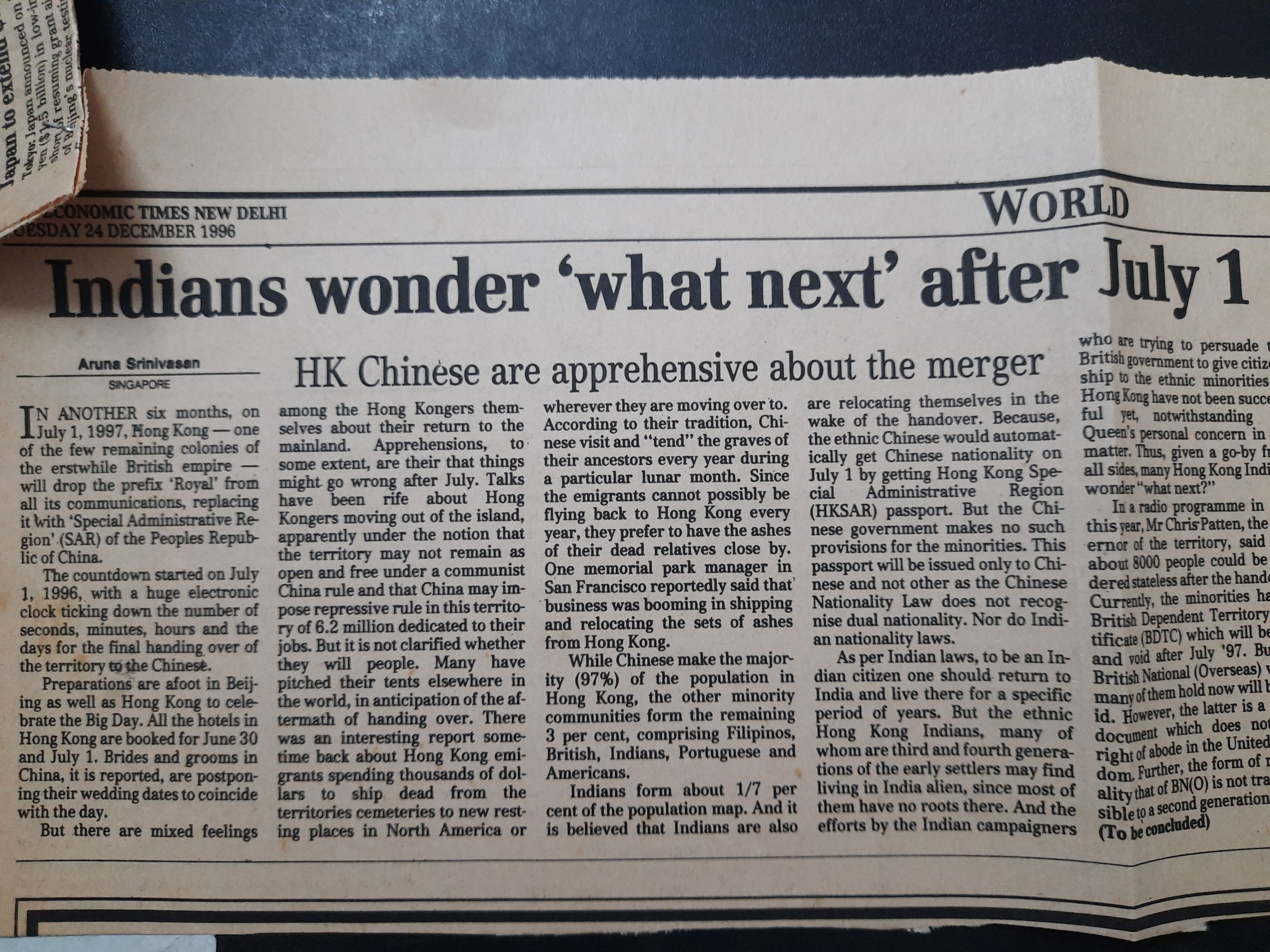
In another six months, on July 1st, 1997, Hong Kong - one of the few remaining colonies of the erstwhile British Empire - will drop the prefix " Royal" from all its communications. The new prefix, " Special Administrative Region " (SAR) of the Peoples Republic of China will be replaced instead.
For the Chinese, it is a great occasion welcoming back a lost province. The countdown in a central market square in Beijing started on July1st, 1996 with a huge electronic clock ticking down the number of seconds, minutes, hours and the days for the final handing over of the British territory to the Chinese. Preparations are afoot in Beijing as well as Hong Kong to celebrate the big day. All the hotels in Hong Kong are booked full for June 30th and July 1st. New hotels are also springing up to meet the demand when the world's attention turns to this cluster of islands. Brides and grooms in China, it is reported, are postponing their wedding dates to coincide with the historic day.

But there are mixed feelings among the HongKongers themselves about their return to the mainland. Apprehensions, to some extent, are there that things might go wrong after July '97. Talks have been rife about HongKongers moving out of the island, apparently under the notion that the territory may not remain as open and free under a communist China rule and that China may impose repressive rule in this territory of 6.2 million people.
Many have pitched their tents elsewhere in the world, in anticipation of the aftermath of handing over. There was an interesting report sometime back about Hong Kong emigrants spending thousands of dollars to ship dead from the territories cemeteries to new resting places in North America or wherever they are moving over to. According to their tradition, Chinese visit and " tend " the graves of their ancestors every year during a particular lunar month. Since the emigrants cannot possibly be flying back to Hong Kong every year, they prefer to have the ashes of their dead relatives close by. One memorial park manager in San Francisco reportedly said that business was booming in shipping and relocating the sets of ashes from Hong Kong.

While Chinese make the majority ( 97%) of the population in Hong Kong, the other minority communities form the remaining 3 %, comprising of Filipinos, British, Indians, Portuguese and Americans. Indians form about 1/2 % of the population map. And it is believed that Indians are also are relocating themselves in the wake of the handover. Because, the government of the People's Republic of China will automatically grant Hong Kong’s ethnic Chinese, Chinese Nationality on 1st July 1997 by granting them Hong Kong Special Administrative Region (HKSAR) passport but makes no such provisions for non-Chinese minorities. This passport will be issued only to Chinese and not others as the Chinese Nationality Law does not recognize dual nationality. Nor does Indian Nationality Laws.
As per Indian laws, to be an Indian citizen one should return to India and live there for a specific period of years. But the ethnic Hong Kong Indians, many of whom are third and fourth generations of the early settlers may find living in India alien, since most of them have no roots there. And the efforts by the Indian campaigners who are trying to persuade the British government to give citizenship to the ethnic minorities of Hong Kong have not been successful yet, notwithstanding the Queen's personal concern in the matter. Thus, given a go-by from all sides, many Hong Kong Indians wonder " what next ?"

In a radio programme in July this year, Mr. Chris Patten, the Governor of the territory said that about 8000 people could be rendered stateless after the handover. Presently
the minorities have a British Dependent Territory Certificate (BDTC), which will be null and void after July '97. But the British National (Overseas), which many of them hold now, will be valid. However, the latter is a travel document, which does not give right of abode in the United Kingdom. Further, the form of nationality that of BN(O) is not transmissible to a second generation.
The champions of the minority groups have been knocking at doors of the Mainland Chinese government as well the British and the Indian governments to solve the identity crisis of the ethnic minorities. One such veteran is Mr. Hari N. Harilela, of Harilela group, President of the Council of Hong Kong Indian Associations (CHIA), and Hong Kong Affairs Adviser to China. He was also in the Selection Committee which elected the Chief Executive designate Mr. Tung Cheehwa, earlier this month. He says , " I have lead several delegations to the United Kingdom requesting them to issue British Passports with right to abode in the UK. Unfortunately CHIA has only succeeded in obtaining the assurances of the British government that if the Indian community comes under pressure they will permit affected people to enter the United Kingdom. However, Indians have full confidence in the future of Hong Kong and have no plans to leave the territory. Beijing also understands and appreciate the contributions made by the Indian community for the success of Hong Kong and would like the community to continue to live in Hong Kong and contribute further to the success of the territory."

Significantly, half of those estimated in such a nationality- limbo status are from South - Asia. Complicating the situation is the fact that most of these South Asians came from the British India - an India which no longer exists. Thus tracing the roots of actual Indians - from the parts of the modern India today- is a next to impossible task which is one of the reasons why the Indian government hesitates to take them into its fold, say sources in Hong Kong.
And the professionals are insecure too to some extent, but are confident that they will have no problem as long as their companies are doing well in the Chinese ruled Hong Kong. Since China has repeatedly assured that business will be as usual in the SAR they are not worried also. Those who are left in the lurch, therefore, are about 4000 to 5000 Indians who hold either BDTC or BN(O) passports. Even if Britain agrees to issue them citizenship, many of the workers category cannot afford to relocate themselves to Britain as easily as the others. Moving to Britain is beyond their economical means. They will not be able to settle in India too because of the cultural, lifestyle and economic gap developed over the generations. The only recourse left for them is to continue to live in Hong Kong with a BN(O) passport which is so lacking in substance that for all practical purposes the minorities will be rendered effectively stateless.

Some observers however point out the incongruity in the whole situation. " When China is taking the province back into its fold in its entirety - the land and resources - it should as well absorb the people in it as they are. Why discriminate the people? Why not treat them as part of the deal ? " they ask. They opine that the Chinese government should amend the law to accommodate the Hong Kong non-Chinese under extraordinary circumstances. But China feels, explain the sources, that Britain did not give the right of abode in UK, for those who held BDTC. So why not they continue to live in the same status - as permanent residents of Hong Kong?

Meanwhile, there are also some isolated views that the problem of " statelessness" is a bit over played. According to some Hong Kong based business sources, most of the Indian community is prepared well for all sorts of contingencies. The total number of ethnic Indians in the region is pegged as 25000. A good number of them are businessmen who came to Hong Kong three or four decades ago in search of trade.
And today many have their strategies planned well in advance - as early as 12 years before, soon after the agreement between Britain and China about the handover. They have been developing alternative footholds by opening offices in places like Singapore, Europe and America. And most of them, the sources say, have managed to secure citizenship in UK, the US, Canada, Australia and so on. Many enjoy dual citizenship too.
And the businessmen who have dual passports and citizenship rights elsewhere in the world are not bothered about the Nationality crisis after '97.
" There will not be any identity crisis as feared by many. Nothing will happen to make HongKongers feel insecure. " says a Hong Kong based Indian businessman who has pitched tent in India and Singapore to safe guard against any " eventualities" which he is certain might never occur." Because, " he asserts, " China has assured that the SAR will remain a free trade area with a high degree of autonomy for at least 50 years. And the relationship between India and China are good. Business in Hong Kong is thriving as usual. I do not see any threat to the Indians in a post 1997 Hong Kong. "
And optimists like him believe that the issue of statelessness for the few thousands ethnic Indians would be solved automatically when the moment comes. " India is keeping quiet on this matter. But what happened in UAE a few months back ? When it was pushed against the wall- when suddenly there were thousands of Indians being rendered stateless, the Indian Embassy there issued them with passports without any great scrutiny into their origin. So, no one can guess what actually will happen at the eleventh hour." he says.

According to sources in the Indian Chambers of Commerce and Industry, Hong Kong, Mr. Lu Ping, the head of the Hong Kong and Macau Affairs office in China, has assured the Indian businessmen that business will not be affected under the Chinese rule. Sources point out that the Chinese top official has even drawn quotes from scriptures and talked about the importance of maintaining one's " Dharma" which for the business community is, business. And as long as the business community minded their own business without interfering in the political affairs, there may not be any problem at all, he has assured. Similarly, the recently elected Hong Kong’s first chief executive - designate, Mr. Tung Cheehwa has promised in his first address this week to the Hong Kong General Chamber of Commerce that free and economic environment will prevail in post '97 Hong Kong.

Assurances notwithstanding, some amount of pessimism does creep in Hong Kong minorities’ minds. Says a business consultant, " We have not ruled out any kind of eventualities absolutely. If things should go wrong contrary to our expectations, we are also prepared too. "

One of the arguments put forward by those who think that all will be well in post '97 Hong Kong is that China is keen to grow into economic power. And the Indian businessmen in Hong Kong contribute enormously to the island's growth. " It is because of the hard work of the Indian businessmen in Hong Kong that they form a significant component of the total trade of the territory. The Indians who figure hardly over 1/2 % of the total population, contribute to 10% of the total trade in Hong Kong. The Indian businessmen are held in high esteem. So much so that they are one of the four Chambers of Commerce, out of some 42 in Hong Kong, to get the prestigious " Certificate of Origin" - an important document for internationals trade. " they explain. As a sign of growing confidence in a post '97 Hong Kong, it is pointed out, many of those who relocated themselves are said to be returning back. Hong Kong’s unique competitiveness is its free economy. And the businessmen who are used to a thriving free market find it difficult to adjust to others which are more stringent with stifling regulations and hence prefer to make a come back.

Meanwhile, the world is watching with concern. Malaysia for instance has announced in a significant gesture that it was willing to employ British Gurkhas in Hong Kong since it is believed that Gurkahs are well trained and are known to be loyal and dedicated to their jobs. But it is not clarified whether they will be accorded citizenship in Malaysia.

The problems after all may or may not manifest in high proportions. But in the event of any helplessness on the part of the few thousands ethnic minorities in Hong Kong, hope perhaps might come in from different directions of the world.

Published in Economic Times Dated 24.12.1996.

Tuesday, May 04, 2004

Aravind Hospital & Dr. G.V

Published in Asia 21 in the issue dated August 2000.

Aravind Hospital- Quality Eye Care to the Poor

What is the connection between McDonald Pizza parlours and eye care for the poor ? Nothing – that is for you and me. But, a visionary ophthalmologist was able to see a connection. During one of his trips to the US, he thought if only we could provide professional eye care to the masses like McDonald parlours roll out thousands of pizzas in a day.

That spark in his brain was not a stray thought. Today, Aravind Eye Hospitals & Postgraduate Institute of Ophthalmology in Madurai, the temple city in southern India, performs over 120,000 cataract operations in a year, and enjoys the reputation of being the largest single eye care facility in the world, performing free and subsidised operations. The subsidised rate for an operation is Rs. 500. This also is charged only for the Intraocular lens(IOL). If a patient can’t afford this amount the operation is totally free and instead of implanting the IOL, the patient gets a pair of glasses after the surgery.

Besides the flagship hospital at Madurai, Aravind Eye Hospital has branches in five cities in Tamilnadu. Their success strategies are observed with interest by ophthalmic institution in India and abroad. So much so that its Postgraduate and Fellowship programmes as well as eye care training programmes attracts many aspiring ophthalmologists from around the world.

When you meet the frail looking Dr. G. Venkataswamy, 82, the man behind this mammoth venture, you think he should relax, now that he has fulfilled his mission. On the contrary, as Chairman of the organisation, first thing as he buzzes into his office at 8 am, is to surf the internet ( yes!), download latest developments around the world in his field, and give his daily directive to his staff about future targets and course of action.

Dr. G. V., as he is known at the hospital, does not feign any childhood dream of giving eye sight to the poor. He landed up in ophthalmology by a queer twist of fate. After his graduation in medicine form Madras university, he served the Indian army during World War II. But an unexpected attack of rheumatoid arthritis which crippled his fingers forced him to return to civilian life. He gave up his original desire to pursue gynecology for his postgraduation and instead picked up ophthalmology. Soon he mastered the art of handling scalpel with his twisted fingers and became a leading eye surgeon in the government hospital Madurai.

It was while working in the government hospital that he began concentrating on taking eye care to the masses. That was when the McDonald concept of delivering quality product at affordable cost impressed him. Why not replicate the success strategy of a fast food service in eye care service ?

An it worked. After retirement from government service in 1974, he began dispensing eye care. He converted his brother’s house into a small hospital with 11 beds. His sister and brother-in-law Dr. Natchiar and Dr. Namperumalswamy, both well known ophthalmologists, quit their respective jobs with the government service and pitched in to help him. And his contacts and friends while he was in government service helped him in providing technical help and funds too.

What is special about Aravind Eye Hospital is that although 60 % of its patients are provided free or subsidised eye care, the quality remains the same for everyone. “ Income from the 40% Paying patients helps us subsidise the costs for 60% poor patients, “ says Dr. Natchiar. Operating under a non-profit Trust called Goval Trust, the hospital’s credo is providing eye care to the mass, at affordable costs.

On the surface it looks like a “Robinhood” concept. But a lot of planning and organization goes into making this a charity venture which is economically feasible too. From registration to consultation and from operation to post operative care, the entire process goes through streamlined procedures. The hospital has a flow of about 2000 patients every day and with the help of computerized procedures they are guided through all the examinations without any chaos.

Aravind Hospital is able to handle such huge volume by keeping its costs low, and sourcing all its requirements form in-house resources. The Postgraduate Institute takes care of the human resources - the professionals, para medical workers and nurses - who opt to work in the Hospital. The lenses which are the costly aspect of any eye care venture- are supplied from the organisation’s lens making plant. Even repairs of medical equipment are done in house at a separate wing dedicated for that.

With a large volume of professionals and nurses, the medical teams work in clock wise precision following a well laid out procedure. The operations are in process almost continuously in 9 theaters which among them have a total of about 33 tables. As one operation is in finishing stage the other patient is prepared ready for the next. And the queue keeps moving on. The medical teams work in shifts and are totally dedicated to the hospital work. Since doctors do not divide their time between private practice and hospital work, they are able to give out their best. Sustained quality is ensured that way. Some of these theatres are reserved for specialized and complicated operations. All the latest development in ophthalmology, including Lasik Surgery is performed here.

Another interesting way the hospital cuts costs is to do away with cots for in-house patients in the “free” service unit. Instead clean mats are spread in huge rooms each of which can accommodate 50 to 100 patients at a time. Sleeping on floor is not uncommon in humid south Indian villages and so the patients don’t feel any discomfort this way. Thus the maintenance costs of beds is eliminated. The “paid” patients, however pay for the extra comforts they receive.

The Postgraduate Institute exchanges visits with reputed ophthalmic institution abroad and the training programmes are two way exercises. The personnel at the Aravind Hospital travel frequently abroad to impart their expertise to others, or they absorb some innovative techniques employed by international ophthalmic community.

There are no prior appointments in both the free and paid wings of the hospital. Patients start queuing up at 4 am, but the queue moves fast. After the initial compute registration, each counter of examination is clearly identified to avoid confusion and the queue moves without any delay. While preliminary examinations are done by trained technician detailed consultation is done by ophthalmologists at the end of the examining counters.

Aravind Eye Hospitals gets its name from the famous saint, Sri Aurobindo. Dr. G.V who is a staunch disciple of the saint, believes in silent talk with the God. Everyday before he enters his office he spends sometime at the “Meditation Room” energizing his spirits.

What distinguishes Aravind Eye Hospital from other hospitals is its work culture. The nurses are young and trained in-house. Once someone asked Dr. G.V to start a “Aravind Hospital” in his city. G.V said, why don’t you open a hospital yourself? You have enough motivation and money?” That person responded, “ I want a hospital with the Aravind culture. People are cordial here. They seem to respect people more than money. There is a certain amount of inner communion or compassion that seems to flow from them.”

And that is the hall mark. A genuine care that runs as undercurrent in the entire hospital activities.
Known as Temple City, Madurai is famous for Meenakshi temple, the biggest temple in the world. The ancient city is also known for its contribution to the growth of Tamil literature. Today, Aravind Eye Hospital stands as one more land mark of which the city can take pride in.
-----------------------------------------------------------------------------------------------------------------

Interview With Dr. G.V.

Dr. G.Venkataswamy, Chairman, Aravind Eye Hospitals & Post Graduate Institute of Ophthalmology.


When Dr. Govindappa Venkataswamy, the eldest son of a farmer in a village near Madurai in Southern India, graduated in medicine in 1944 the World War II broke out and fired by patriotism he joined the Indian army and went to the war front. But he had to come back in three years, after developing severe rheumatoid arthritis. He was bedridden in a Madras Hospital for over a year. With acute stage of arthritis, he could not stand on his feet nor could hold a pen to write. But he was determined to carry on with his life with a positive attitude. For his post graduation he decided to take ophthalmology and learnt to do all the eye surgery with his crippled fingers. Soon he conquered his disability and used to do 100 eye operations in eye camps.( free camps held in rural area to promote eye care among he masses.) When such determination is channalised to charity work, it can do wonders, which is what is happening at Madurai, a city in Southern India.

Aravind Eye Hospitals & Post Graduate Institute of Ophthalmology, Madurai, a 1,16,000 sq.ft, 925 bed eye hospital cum institute with a patient flow of about 2000 everyday, renders subsidized eye care to 60% of its patients. As its founder –chairman, Dr. Venkataswamy is a household name in the southern districts of Tamil Nadu.

Honored by the Government of India with, “PadmaShree”, one of the prestigious awards of the country, and “Helen Keller International Award” by the UN for his pioneering work in fighting Cataract Blindness, Dr. Venkataswamy, 82, is continuing his work with the same zeal he began with. He is keen to keep up with the fast changing world. So much so, after a morning meditation he is at his office sharp by 8 a.m. everyday. And his first job is to log onto the Internet and find out the latest update on eye care worldwide. He not only updates himself but passes on the information to his team with his own ideas to to be implemented in the hospital. “ First thing all of us get to see on our tables are these little missives from the Chief…” remarks Dr. P. Namperumalswamy, Director of the Hospitals.

Asia 21 spoke to him about his motivations, his strategies and his visions.

What motivated you to start this institution? Was it just sudden or was the idea simmering in you for a long time - a childhood dream?

No..no… The eye career came much later. When I was in the government service in 1956 to 76. During the later part of these years, I used to feel how nice it would be to run an institution. During this period, Government of India had borrowed a lot of wheat and maize and all those things. India had taken about Rs. 5000 or Rs.10000 crores loans. America said that they did not want the money. But will keep the fund aside for health care and other development work in India. So there were lots of grants at that time. One of the areas identified at that time was rehabilitation of the blind. Initially I had a grant to start a rehabilitation center for blind here. That gave me the opportunity to visit America often and also helped me build up contacts with several leading American institutions. That gave me the first motivation. How nice it would be if we could have institutions like these in India, I thought. – dynamic, doing research….

So, when did you actually launch this venture?

After my retirement in 1976, we started in a small way.

How small? Could you elaborate the beginnings?

You see, in those days even as we were in government service we were allowed to do private consultation also. Only consultations. For operations we had to come to the hospital. My sister who is also an ophthalmologist was with me. And her husband, had his own practice. When I retired I had a house of my brother. We converted that into a clinic, where I can do surgery also. We put a small shed which can accommodate 70 to 100 patients for consultations and we made a small operation theatre also. Since my sister was still working in the government, she would support me in the evenings. Even when I was working for government, we used to have eye camps. During those days I met Sir. John Wilson, founder – director of Sight Savers International ( formerly the British Empire and then the Commonwealth Society for the Blind). He used to support me even while I was working in government. Initially he gave me ideas and monetary support to organize eye camps. My contact with people invo
lved in eye care, and philanthropists grew.

Did you start giving free treatment even as you began your private clinic in 1976 ?

Yes. The philanthropists and the people with whom I worked during my service years wanted me to continue my work for the blind. That was a period when a lot of Gandhians ( those who follow Mahatma Gandhi’s ideals) institutions like Gandhi Gram, were interested in rural development and they helped me with immense support. The programme got popular and drew the attention of big industrialists who wanted to help the cause.

What was one major aspect which prompted them to help you?

They could see that many sightless people could get their eye sight back with simple operation, in a programme which did not have huge investments.

The government service achieved the same objective. How different was your service from the existing government service?

People put a lot of trust in me as a committed person. They had faith in my Gandhian values. Even though I was doing a free service people had confidence that I would not compromise on quality. For instance, our camps were meant for poor people. But even rich would come there and say that they would like to be operated by me.

They were willing to pay for you?

They were. But I would not accept any money. But they were supporting the camps. For instance, Lions club organised camp in a small town where we did 700 operations. The government used to give us only Rs. 750 per camp. These organizers would give me support saying, ‘ Why do you bother about money? You do the operations. We will feed the patients and look after them.’ The rich people who were treated by me would organize the eye camps. The concept of eye camps which located the people with eye diseases became popular. So, when I started my private institution the demand was already there. Initially we had about 20 to 30 “paid” beds also. The ratio was something like, 70 “free” patients and 30 “paid” ones. The eye camps ensured the constant flow of patients. On any national day or festival, or to mark the birthday of my father – these free eye camps were held.

So, the eye camps became a social trend?

Yes. This way community participation also increased. People began to organize eye camps when they wanted to do some charity work to mark some special occasions in their personal lives.

How did you get external help to build your infrastructure?

Sir. John was willing to help me. Also, when you are committed, help comes to you from all directions.

How did you manage to rope in the team of professionals to help with you in charity work?

Since I had the support from many people, I could afford to pay salaries to professionals, who were willing to lend me a hand in my work. There were occasions when we faced financial crunch and we had to raise money by mortgaging the house. But luckily for me my entire family pitched in.. For instance, the buildings were constructed by my brother who is an engineer and has a construction firm. Couple of years later, my sister and her husband left their government service and gave me professional support full time. And those who worked for us were willing to work long hours with minimum compensation. Also, our growth was gradual. We expanded only when we had enough funds.

What was the most difficult part of those initial years?

It was the public perception during those initial years. People would say, ‘ah… he is a retired old man…. He is running a small clinic…’ They could not imagine that someone could think of building an institution after retirement. So, it was a big job to attract doctors to work for me. They thought that they did not have much career scope with me.

How did you mange to convince them?

By giving them good salaries. Many of them did not have any jobs to begin with. Our strength was our reputation as good eye surgeons. People realized that with talent we could have made more money for ourselves. Instead they saw that we put all our money into this institution. Moreover ours was not just eye hospital alone. When we began to offer post graduate programmes in eye care and hospital management, our credibility as a non – profit making institution was established. Soon we started building our own man-power through training courses. Soon we got affiliated to Madurai University and got recognition from Indian Council for Medical Research also. Today we run 7 fellowship programmes, besides other specialty courses.

Whom do you identify as your role model?

Sir John Wilson. He invented me. In those days World Health Organization did not have any specific programme for eye care. There were some organizations here and there for the blind. He founded the Royal Society for the Blind. In 1972-73, he brought together all the associations at a meeting in Jerusalem. There he announced that every country should have a National Programme for Control of Blind. (NPCB). India was one of the countries agreed for that.

You have often expressed curiosity about McDonald’s franchise concept. Do you think it can be copied in your field to evolve more hospitals on Aravind’s model.?

We are not strong enough for that. For one, the main motive behind franchise concept is making money. In a fast food chain, 20 to 30 thousands hamburgers are rolled out at a time.
However, the training we give under our “Capacity Building” programme is similar to that. In our client hospital it is already being run by the locals. We try to find out how far we can improve upon that. If you open branches or run a franchise, a lot of care should go into monitoring the uniform quality. We also have to take into account the local culture, which we should adapt to our way of doing things. However, we have 5 branches in TamilNadu which are run on same pattern as our Madurai hospital.

How do you go about replicating your model in other places?

Today there are numerous people without eye sight throughout India and the world. And there are eye care centres. Our experts visit many states and even other countries in Africa and South East Asia to impart training and help set up units on our model. Lions International has a US$ 140 million global programme for blindness. They have asked us to help in these countries. We basically give training and help set up units by utilising the available resources. My dream is to bring eyesight to the masses everywhere in the world.”

You are more inclined towards charity work. But not everyone can afford to be philanthropic. What is your advice to run a successful eye care centre serving the poor and at the sametime making it economically viable?

In any management, the leadership is very important. Secondly there should be realisation that the world is shrinking and globalization has brought more awareness in people. They expect quality. As long as one can offer quality services at affordable price there is nothing wrong in making profits.

You have built a brand equity in eye care services. When you impart training to others do you market your brand in terms of certificates or any kind of acknowledgement? How do you attach value to the training you gave?

When we give training it is just practical approach. Our name anyway spreads through word of mouth. A lot of people come here from all over the world to our institute. And after their training most of them add “Aravind Alumni” to the list of their qualifications!

About your concept of free treatment for the poor – is it absolutely free?

Not like that. Most of the patients are ignorant of their eye problems and many hesitate to have any treatment at all – because either they are not aware that their problem can be cured or they think it is unaffordable. Most work in the farming fields. If the eye sight is poor, they just take it as their destiny and would remain jobless. Some are afraid that the treatment would be very expensive. But at the same time total free treatment hurts their dignity. So, we tell them that we would charge only for the lenses sutures, and the medicines and if they could pay that nominal charges he can get the treatment and go back to work, it gives them confidence. Paying an amount – however small it might be – gives them a sense of dignity. If it is totally free, they will not realize the value also. Today some resent total free treatment. They volunteer to pay. Also, a lot of the villagers have realized the importance of getting their vision back and they have also realized that th
ey need not live blind, cursing their fate.

Could you relate a moving experience in your long career?

There are many. But, what worry me always is the social repercussions of the blindness. For instance, there was this widowed mother. She had two sons and a daughter – all of them laborers. When she lost her sight gradually she could not go out for work. The sons and the daughter refused to support the blind – therefore unproductive – mother. She went to live with her sister and came to know about our hospital. She got her sight back and went back to work. Now, the sons wanted her to come back. But this woman got wiser by now and told them that she would stay with her sister till her end.Similarly in another example a young wife who unfortunately got cataract, was deserted by her husband. Some others feel that it is a waste of money or effort to give eye care to the old relatives. Such social behaviors are real tragic.

What is your dream for future?

Right now, I want to keep a multimedia database of all our activities and organizational system. We have video records of all our operations. Similarly I want records for housekeeping also – preferably in Tamil. ( native language) So that the bottom levels staff can understand the concepts clearly. And I want my hospital to build a strong web network and reach more people world – wide, through video conferencing and other communication tools.
---------------------------------------------------------------------------------------------

Friday, April 09, 2004

Aruna Srinivasan.
Dateline:
Singapore: 22.4.1996.

Contributed to Womens Feature Service and was picked up by a couple of European publications and Lokmat Times ( dated - 26.5.96) in India.


Politics is not their cup of tea

Recently Straits Times, the Singapore's daily, did a survey on potential women candidates for parliament. All ten of the women interviewed were already holding high profile posts in various fields. But when asked about their political ambitions, six declined to comment and the rest four stated that they were already happy with whatever they were doing. In short, politics was not on the cards for those women who were perceived as leaders in their own right in their respective fields.

The world over, women do not take to politics as readily as the men do. Women heads of state are not in overwhelming majority though women do figure largely as members of parliament or at grassroots and community levels. Singapore is no exception. And like the rest of the world Singapore also realizes the absence of women in the parliament and wants to do something about it. The Prime Minister Goh Chok Tong's open concern recently about the lack women's participation in Singapore's politics evidently shows that this island nation is trying to add colour to her parliament by roping in the women talent. He had said that he would be happy to see at least two to three women in the coming polls, although his original target was six.

But there are not many takers for the Prime Minister's appeal it appears. Singapore women just are not willing to have a feel of the parliament. At least not yet. However, no one in the country, is averse to the idea of a woman politician or even a woman prime minister as revealed from a random interview with a cross section of the people in Singapore by this correspondent. A majority of the individuals one spoke to, agree that women should enter politics and that there should be more representation of women in the parliament. And the reasons were varied. While some observed that women are increasingly becoming educated and independent and therefore are capable of voicing the needs of women in an effective way in parliament, there were others like Mr. M.P. Kanisan, CEO, Singapore Indian Development Association (SINDA), who felt that women should be represented in parliament not only for the cause of women but also in their capacity as individuals, working for the welfare of the society in general too. And some others pointed out that more women candidates could actually translate into more women voters.

Says Nominated Member of Parliament, Dr. Kanwaljit Soin, " The government might have felt the need to rope in the women voters, by allowing more women candidates in the election. Second reason could be that they might have realized that women's perspectives do matter in any issue and that they are capable of bringing in solutions and suggestions from different angles. After all diversity of opinions and ideas is important in parliament. As long as you don't have equal participation of women in the parliament how can you have a balance in the debates and the discussions and the subsequent decisions of the parliament? Thirdly it is a way to utilize the human resources. Women form 50 % of the populace. Their potentials ought to be tapped in for the progress of the country. "

Born in Punjab before pre-partition period and migrated to Indonesia with her family, Dr. Soin, was educated in Singapore when her businessman father decided to give her proper English education. An Orthopedic surgeon by profession, her interests in women's issues through the organization called "Association of Women for Action and Research ( AWARE )of which she is a founder member, brought her to the threshold of politics when she was nominated by the government as a member of parliament in 1992. The concept of nominated Member of Parliament was introduced in Singapore in the early nineties. Till 1981, there was hardly any opposition in the parliament. So to bring in different perspectives to debates and issues, certain members of the society were nominated to the parliament by the government. This scheme was started only in 1991. Ever since her nomination to the parliament, Dr. Soin has been raising several issues in the parliament in the interests of women as well as the society as a whole. Her recent attempts to introduce a bill on "Family Violence " in the parliament kept the media and the nation engaged in a series of debates and discussions for months. Unfortunately the bill was voted against.


Confident of women's capacity to achieve great things in life, Dr. Soin is quite vocal about women entering politics. " Of course women should take an active interest in politics. I am sure there will be more women entering the parliament in future. A women Prime Minister for Singapore might be a forlorn thought today - but not in ten years or so. By then women might attain that position. But today there is not a single woman full minister in the PAP party. Also, women enter politics only after they are free from their family commitments - say, in mid forties. But men enter sooner - in their thirties. Therefore women find it harder to climb the political ladder and hence there are fewer women at the top. Only after there are a critical number of women at the top, can a woman Prime Minister emerge, " she elaborates.


There were a few individuals however like Josephine Lim A.C. a real estate agent, who felt that politics is not for women and that a woman's priority lies with the family. " But then, it is my personal view. If a woman has what it takes to be a politician - the vision and the passion to work for the country as a whole, plus the temperament to face the odds - then I don't see why she shouldn't take to politics. Yes it is not impossible for a woman to become a prime minister here. But it may not be in the near future. Because in Singapore politics, women are not yet as experienced as the men are. And somehow women don't like to enter politics. They think it is men's job. " she observes. And the potential candidates interviewed by Straits Times appear to share similar sentiments if not in so many words. Why do the Singaporean women shy away from politics ?

It needs a an insight into the history. Circumstances, which lead to Singapore's emergence as an independent state, were different from those, which brought about the change in other ex-colonies in Asia. Most countries had to wrench their freedom from the colonial master. Whereas Singapore's was a case , where the independence came unexpectedly upon leaving the Malaysian federation. Singapore leaders often have observed how the nationhood was thrust on them. Thus, although Singapore had its own share of battle for independence, her birth as an independent nation did not involve the kind of mass movement, which most of the newly liberated colonies had to undergo. And since women were part of any mass movement, many countries witnessed a generation of women who took active part in politics. But in Singapore such a necessity did not exist.

Singapore's history traces back to 1819 when Sir Stamford Raffles established a trading agreement under an agreement between the British East India Company and the Sultan of Johor and the Malay ruler of the island. Later Singapore was incorporated with Malacca and Penang to form the Straits Settlements, which was under the control of Governor - General of India for sometime. After the Second World War the island was made a crown colony when six elected members out of a total of 22 members for the Legislative Assembly were included for the first time. It was in 1959 that the first General elections were held for Legislative Assembly of the State of Singapore and People's Action Party (PAP) came to power. When the Malayan Prime Minister Tunku Abdul Rahman proposed a proposal for a formation of Malaysia, the Singapore government gave its support for the federation of Malaya, Singapore, Sarawak, Brunei and North Borneo. With the formation of Malaysia, Singapore became independent within the federation of Malaysia. By 1965, Singapore became a fully independent and sovereign nation on separation from Malaysia and that was the turning point when the State of Singapore became the Republic of Singapore.

" Singapore's birth was a unique one, in marked contrast with the birth of some other nations in Asia, " observes Dr.Kripa Sridharan, a political scientist working in the National University of Singapore (NUS). " Singaporeans - both men and women - by and large are not inclined a political career. The reason for urging women to enter politics is perhaps to create role models for the future generation. For women, politics is a public activity and not many are willing to expose themselves to its perils. And most of the women who are career minded think that if you have talent, you will do well anyway in any field; there is not enough motivation to enter public life for them. They are very private individuals. "


It was not that Singapore never had any women politician. " Singapore Woman," a collection of works edited by Alien K.Wong ( now the senior minister of state for education and Health ) and Leong Wai Kum, throws light on some of the prominent Singaporean women who were active in parliament in the fifties and right through the early seventies. Infact, according to the book, at the dawn of independence in 1965, "....women activists were enlisted to serve in community centres and to reach out to the masses in explaining government policies....." At that time the number of women in parliament were three, which soon reduced to nil with the exit of Madam Chan Choy Siong and Mrs.Devan Nair. And the vacuum continued for nearly 14 years till a set of three elected women members of parliament arrived on the scene. One of the reasons cited for the lack of woman representation in the parliament for a long period of 14 years was that the new nation was keen to have only a group of well-educated and qualified members at the helm of affairs.
And obviously not a great number of women in those days possessed the necessary requisites. The book observes that in those days " ...... there was a diversion of women's efforts away from women's issues. " At one stage Madam Chan Choy Siong was the only woman MP, left to do women's work single - handedly. " ..... She persevered and even attempted to persuade the government to start a Woman's Institute, but failed to move in line with the party's new thinking. In 1970 this pioneer finally stepped down to make way for new PAP members who would all be better educated than many of the old guard." But towards the eighties, the Singapore women became well educated and efficient - were found fit enough to take up leadership roles in public life. And thus the eighties saw the return of women to parliament albeit in limited numbers.

But the trend failed to catch up in a big way due to various social factors. First, the women by now were caught up in a different mission; that of improving the economical status- of the individual families and in turn that of the nation's. In general, a man or a woman takes to politics, usually driven by an urge to serve a cause - often one, which sprang from miseries of one or the other kind.

Says Sridharan, " At least if you had cruel social evils which are the causes for organizations and leaders to emerge, you would have perhaps seen some women leaders - apparently fighting for a cause. " When life is on a placid level socially, there is no strong motivating element in the society to create leaders. But in the budding nation that Singapore was in those days, the concentration was totally on building up the country to meet the challenges of the ever changing world ". Adds Kanisan, " There was never any need for anyone to enter into politics - even men did not enter into politics in a big way. People were confident that the government was in good hands. And women thought that it was men's job. And as for themselves they were busy with their own jobs and were striving to excel in them. They, therefore, hardly had the time or the motivation to enter into politics. "

Lack of interest in politics is one obvious reason why Singapore women have not taken up to politics although there is no dearth for capable women in Singapore to play a leadership role in politics. In fact the number of women heading the organizations in government departments as well as in the private sector companies appears to be growing tremendously. On the other hand there seems to be a need for more fresh members in politics who are capable and efficient enough to continue the development works of the present generation of politicians. The leaders often stress in their public speeches of the need for younger generation to take an active interest in politics. Observers point out that the present generation of leaders might be feeling that the potentials of women should be tapped into public life also since they have already proved themselves in other areas.

But the women don't feel the urge for public life. " I would not consider entering politics because there is plenty to do where I am. My two concurrent jobs have allowed me to satisfy my sense of public and political duty, " observed Professor Chan Heng Chee, who once was Singapore's permanent representative to U.N. and presently the director of Institute of South-east Asian Studies and executive director of Singapore International Foundation, in her interview to the Straits Times. Also a political career in Singapore is not something an individual decides by herself or himself. Nor does a leader emerge automatically by mass support as it happens in other parts of the globe Four of the women have expressed that Singapore's political culture was such that a person had to be invited into the fold, to become a politician.


Says Soin, " In Singapore the political agenda is set by the government. The attitude is that ' you have elected us to govern. Then trust us. We would do the best.' We have a Group Representative Constituency system wherein certain areas are pooled into one big constituency and four members from a party, stand for election in that constituency. Every contending party should ensure that out of the four candidates one is from a minority community. This way chances of a minority community missing a parliament seat are eliminated. Similarly, I once mooted the idea to create a scheme wherein one of the GRC candidates must be a woman. But somehow the suggestion has not been taken up."

Changes and transformation don't happen overnight in any society. A woman Prime Minister may not be shaping up presently in Singapore. But nonetheless, the nation is gearing up to have more women in the parliament in the coming elections - if women give a serious thought to the call from the Prime Minister. It is a question of time.

Friday, December 26, 2003

"De – dynasting" the family business

Published in Asia 21, Jan 98 issue.

When Vikram Lal, the second generation inheritor of Eicher Limited, a family owned company in New Delhi decided to expand his business by opening an unit in another town far away from the original plant in Delhi, his aunt asked him, “Well, you are going to expand your business. Alright. But which of the family members will you send there to look after the unit?”

As a member of a traditional Indian family, she had her reasons. One of them was that Vikram Lal was the only son of his father who first started the Eicher Limited decades ago in 1959 as a tractor manufacturing company. And there were not many in the family to take care of different areas.

But it never ever occurred to Vikram Lal that one needed a family member to delegate areas. A competent outsider can do the same job was his line of thinking. So he answered his aunt that he was going to hire an outsider – a professional manager – to take care of the new unit. The aunt couldn’t digest that easily. “But be careful. You will never know about an outsider. He may not be that reliable…..” she cautioned him.

Recalling the incident today after nearly three decades, Vikram says, “ People in those days had different mindset. They believed that an outsider will not be as loyal to the company as the family members. But in reality, family members have turned out to be unreliable in some cases.”

For years, the driving force behind an Indian business venture has been the entrepreneurial spirit of the few visionary individuals. As the businesses grew over the passing years, and the patriarchs who started off them began to disappear, the businesses were handed down to the inheritors and the concept of family businesses took its root. The inheritors took good care of their inheritance and more often than not, contributed their might too, for further growth. Thus the business empires came into being.

But the scenario did not continue for long. As the business expanded into multidimensional force with each of the new area headed by a member of the clan, internal problems like clash of personalities or divergent thinking began to emerge.
What followed was a natural consequence. Splits and disintegration of the assiduously built empire or even a virtual wipe out of the original business. According to one estimate, about 23 major family concerns have fragmented between 1990 to 1997.

But the residual effect was not lost on the business community. The increasing global competition forced them on an introspective mode. In a changing international business scenario, where acquisitions and amalgamations are order of the day to consolidate business and increase market share, was it not foolish to allow an existing empire to disintegrate over family feuds? They began to ponder.

And what emerged was a realisation that more than the family managing the business, managing the company and the family was more important. Particularly in the Indian context, the economic liberalisation and the entry of multinationals was the catalyst in bringing in a change of mindset.

In the past, Indian businesses did not have much of a competition – particularly international competition. The industry was monopolised by a few local players and to large extent by the State. And in a period where a state license was required to produce or trade almost anything, there were limited players in every field which ensured the monopoly. And the supply was always lesser than the demand. It was a sellers market where everything that came out of the assembly line found a ready market.

Says Anil Sachdev, Managing Director, Eicher Consultancy Services, “In those days, there was never a motive to change or improve one’s product quality. Even after the liberalisation many business houses thought that it was a bad dream which would go away eventually. But when that did not happen and when the reality was reinforced by successive governments who went on with the reform process, they began to prepare for the inevitable change.”

It was at this juncture that many business houses discovered that they lacked the professional skills to handle the increasing complexities of business in global context. Earlier they used to do what they liked entering into any area they fancied. The line of thought was that if they succeeded in one they would in everything. Also, the traditional mindset was that the owner is the boss and only his family had the say in every decision making irrespective of the needs of the market place. So, a member of the family usually held the decision making key positions. The idea of professional expertise in a chosen area was not in their scheme of things.

But the pressure of competition was something they were not prepared for. When the going got tough in international market, they realised the importance of professional approach to their business – if the family does not have the professional expertise it was felt necessary to induct outsiders into the management. The realisation came that just by virtue of being a family member, one does not automatically deserve the thrown. And where necessary, the owner should give room for professionals to lead. Thus emerged a paradigm shift from owner manager to professional managers for key positions.

Meanwhile, some business groups who did not want to give away the leverage to outsiders, trained their own kith and kin in a professional way to lead the business. Many of the younger generation family members today are professionally trained in managerial or technical skills.

Either insider or an outsider, the manager must have a professional approach. Says Vikram Lal, “Professional managers per se does not guarantee success, but professionalism does. And the Indian business houses have learnt this through experience.”

Some business houses in India had set on professionalism from their inception. If the Tatas and the Birlas, the pioneers of the Indian industry are earlier examples, Eicher Group, Wipro Group and Infosys are some of the later day examples.

When Vikram Lal the patriarch of Eicher group took over the reins in ’75, on his return from Germany where he acquired his engineering qualification, the family business was in shambles. “I felt that if I have a constant fear that the company will go broke I may have to live with constant tension which I thought was too much to bear. If I wanted the company to survive I had to look at it from the professional point of view and I was a professional myself. To some extent I had also acquired the egalitarian approach of German way of living. The attitude of hierarchy was less. Since I have worked in shop floors and I knew the dignity of labour.”

Thus, hiring professionals for various key positions was a natural process for Vikram Lal So it was for the Tata Group and some other significant business houses which from the earlier days had appointed professional managers to head some of its divisions.

But not everyone bought the idea that professional managers need to be hired for the success. Like mentioned earlier there were several business houses which still remained glued together as a family and instead of hiring outsiders, they trained themselves and got geared up to face the challenges. But some business houses have not been so lucky. In the absence of right approach to family as well as business, they failed to pull the strings together. They simply disintegrated or vanished under the weight of family feuds which subsequently ruined the business itself.

In a recent conclave organized by the Confederation of Indian Industry (CII) to focus on the problems faced by the family businesses, Arun Bharat Ram, Vice Chairman & Senior Managing Director, SRF Limited, a Delhi based conglomerate emphasized the need to address certain vital issues in family businesses. He belonged to the family conglomerate which was a Rs.2000 crore mighty corporate under a single umbrella banner called DCM, before differences among the family members split the group into several insignificant outfits. Emphasizing the need to manage the conflict between past traditions and the challenges brought in by the changing global scenario, he reflected on the importance of keeping together a larger unified corporate entity.

Like DCM, Apollo Tyres, and the Modi Group, are some of the conglomerates which got fragmented due to family feuds. The reasons for discord in the families, as pointed out by Arun Bharat Ram, lies in internal aspirations of each family member, the divergent attitudes and lack of, or perceived lack of competence in a given area.

If one member of the family was given a specific area which is seen as significant by another member who was given another area which, in his/her opinion is insignificant, the ego tussles emerged. For long these issues remained in closet strictly within the walls of the family. But today under pressure to perform, many business houses have begun to introspect and address the problems of managing the family. They have realised that by splitting they have not gained anything nor have they been able to meet the pressure of changed business climate where quality and ability to respond or adapt quickly to consumer needs are essentials of staying in business.

If the DCM story is an example of family businesses which have failed to stay together, there are the likes of Murugappa Group or TVS Group to illustrate success stories. “In a country like India where 93% of the industry is family businesses, it is important to find ways to stay together and ensure that your market share does not go down in splits and disintegration.” Says N. Srinivasan, Deputy Director General, CII.

When Vikram Lal took over the reins and was determined to make a turn around, he consciously took a decision to avoid inducting family members in the business. So much so, the company evolved a policy which holds good to this day that no relationships of any of the employee including the owner himself will join the company. Even if a couple happen to get married after joining the company, one of the spouses always left the job, respecting this rule. “ Somehow I felt that having your close kith and kin at workplace will affect the decision making process. Particularly in India where the bonds are very strong.”

So, he has set an example himself. Today, he has handed over the reins to an outsider Subhodh Bhargava, an engineering professional who joined the company in the seventies and has literally grown along with the company. As Group Chairman and CEO, he heads the Board of Directors – a body of 12 members. And he stepped down before his only son ( 25 years, Masters in automobile industry, and training in Germany ) joined the company’s ranks at the starting level. And as for himself he sits on a Supervisory Board, which has three members – again not family members- which supervises the over all performance of the group. Having handed over the reins, he has chosen to stay away physically at far away place from the corporate centre. “If I continue to have my office there, people would drop in to see me and corporate issues might invariably crop up and that may have my indirect influence. I expect the present management to have completely freehand in the day to day running of the show.”

However, appointing professionals in key positions per se does not guarantee success. “There may be failures where even induction of professionals could not help the business. But this trend of inducting outsider professionals in the management at the board level is a recent phenomenon and enough data has not emerged to establish any failure story.” says Arunav Banerjee of PriceWaterHouse Coopers, the multinational Consultancy firm.

Another issue which needs to be analyzed in the above scenario is the employee attrition level. In these days when human resource is in high demand, what about the problems of loyalty and the high turn over at top management level? “While employing outsiders at key posts that problem does need to be taken into consideration. But when a candidate is chosen for the key post his loyalty factor was one of the main consideration that were taken into account. Often they are employees who have grown along with the company and has the company’s interests at heart.” He explains adding that the professional satisfaction also depends to some extent on the freedom he/she is given. “As long as the professional CEO runs the business on the lines already set by the owner, there may not be any problems. But what happens down the line – if the professional management differs on basic principles laid down by the owner?” he voices his doubt.

Vikram Lal answers, “In Eicher, we have this Supervisory Board which has certain predefined role with a broader focus on the group. Approval of the strategic plan for the group for three years is one of them. And every half-year we meet and review the group’s performance and discuss various issues with the Board of directors. This is not to direct them, but just to keep us informed. If there are differences in policies in future, we will take decisions as long as it falls within our realm. Otherwise, we would not interfere. The overall benefit of the group is the priority and we will review only those matters which will increase the risk of the group.”

Just as the family business tend to view the outsider professional with suspicion, the professionals on their part does not settle for a family managed company that easily. Brought up in a broader outlook, many of them dislike any hierarchical attitude or unprofessional approach of the some of the family concerns. Notwithstanding the assured “professional Approach” some companies continue to exhibit autocratic qualities in the management decisions. Professional managers avoid such companies or do a thorough research about the company before accepting an offer.

The question is not whether companies have to hire professionals to succeed or even to stay above waters. The bottom line is a need for a mixture of professional approach, the basic acumen of entrepreneur and the adaptability for change to meet the market needs.

The family can own the stakes of the company but that does not automatically
grant them right to manage the company. You need professional managers – from within the family or hired - who can take objective decisions to the overall benefit of the group.

SIDE BAR -1

The southern India based Murugappa Group which has diversified ventures spanning farm sector to electronics has managed to stay together as a family and has kept the group in one piece. Founded by Diwan Bahadur A.M.Murugappa Chettiar in the 1930’s the family’s roots trace back to money lending business in Burma,(Myanmar), Malaysia, SriLanka and Vietnam. The family returned to India in the 30s and started stock broking operations and rubber plantations. By 40s and 50s, it wound up the foreign operation except SriLanka and took roots in India. TI Cycles India Ltd was the flagship company at that point of time. Gradually diversified into other areas including financial services and today has grown into a Rs. 2900 crore group.

What ensured the success was the shared family values, trust in the leadership and among the family members themselves.

The code of conduct was laid by the patriarch and was closely adhered to for generations. And who would be the leader was always clearly defined and the rest of the family accepted it. The dynamics of the family business was clearly defined as objectives of family and objectives of the business. The interests of the two will not supercede the other nor will interfere with each other. Every basic issue involved in the dimensions of running a family business was pre defined through series of questions. Is discipline held should be held as norms or a process definition; what is the process of sharing resources? Is it seen in monetary terms or in skills?; what is the source of security ? Money in hand or effective managerial control of business? What is the task of the family? The mission. In every area, clear norms were set and roles of each family member clearly identified. Conflicting issues were discussed in open manner but the leader’s verdict was the final word. Again, the leaders’ roles were predefined too. There was one leader for the family matters and other for the business. Neither will interfere in the others’ realm.

Interestingly the Murugappa clan had a unique set of rules for the family members. The perks and the salaries were uniform to all members of the family depending on their family status in their generation. Thus the cousins of the same generations enjoyed the same kind of perks and facilities irrespective of their position in the business. The rule applied to their spouses too. Since each family member respected the family values, and had the courage and conviction to stand by the values, the ego tussles did not emerge.

Similarly, business ethics were strictly adhered to. No unethical business practice was encouraged by any of the family member. And if there was a family crisis, the whole family rallied together irrespective of their respective preoccupation in the business.

Murugappa Group has been a good example of combining both business and family with good synergy. While, they adopted a method best suited to them some other group might have different parameters to combine the two entities. What holds right for need not necessarily be the universal rule. And the corporate world today is still analysing and rediscovering their own strengths and weaknesses. The idea is to find means to co-exist without hurting each other. And one cannot succeed at the cost of another.

SIDE BAR –2

What Constitutes Family Business?

- Family business is one where the family or the ownership has Strong influence in the day-to-day running of the management.
- It is that business where there is limited segregation of roles between ownership and business control.
- It is a business where promoter interests invariably come before corporate interests.
- A business where top management being family, is accountable to only to itself.
- Practices in family businesses reflect the social/ business conditions which were prevalent.
- Many family businesses are in a stage of transition. One of the area of change is management structure and practices.

Source: Confederation of Indian Industry.


Five keys for successful Family Business according to John L. Ward; Ralph Marotta Professor of Private enterprise; Loyola University, Chicago.
1. Respect the challenge,
2. Understanding,
3. Communicating,
4. Planning,
5. Commitment.

Classic challenges for a Family Business according to John L. Ward.

1. Balancing Family and Business
2. Succession
3. Family Harmony and commitment,
4. Resistance to Planning
5. Trusting Non-Family
6. Financing Continuity.